

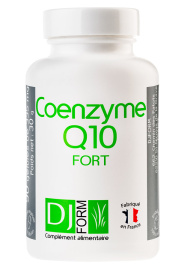

200 mg of coenzyme Q10 ubiquinone per daily dose (i.e., 2 capsules).
 Read the 6 reviews
Coenzyme Q10, naturally present in all our cells, is an essential compound for the production of adenosine triphosphate (ATP), the molecule that produces 95% of the human body's energy.
Closely related to vitamin K and a very powerful antioxidant, it activates the energy production necessary for the normal functioning of our body, protects our cardiovascular and immune systems, and slows down skin aging, notably by helping to fight against free radicals and oxidative stress.
Our body is capable of producing coenzyme Q10 and covering its needs through diet. However, our diet may be deficient in it depending on our eating habits. Furthermore, our production of coenzyme Q10 decreases with age.
With the nutritional impoverishment of our diet, changes in our eating habits, and the stressful conditions of modern life, we may come to lack it.
A deficiency is notably recognized by the quality of our skin: loss of elasticity, firmness, or radiance, and the appearance of fine lines and early wrinkles.
Supplementation can be useful from adulthood and is generally advised upon the appearance of the first signs of wear and tear (drop in energy, persistent fatigue, etc.).
Djform Co-enzyme Q10 Fort is derived from natural fermentation to guarantee extreme purity (99% Co-enzyme Q10) and a product free of solvent residues.
It is bioavailable and perfectly assimilable.


The "HPMC plant-based capsule" is only plant-based in name! Behind a marketing facade, the HPMC plant-based capsule actually contains chemical residues. To always offer you the highest quality products possible, DJFORM uses pullulan capsules, suitable for vegetarian, plant-based, and vegan diets. Instead of wood cellulose, which is indigestible for HPMC-type plant-based capsules, pullulan capsules are food products derived from sugarcane that our body is able to digest.
To learn more, please read the following article by Julien Venesson:
Q10 in the form of Ubiquinone or Ubiquinol?
Our cells are veritable little energy power plants. Cellular metabolism, thanks to the mechanism of oxidation-reduction, involves a transfer of electrons between the oxygen molecules we breathe and the molecules of glucose or certain fatty acids from our diet (respectively carbohydrates and lipids). By capturing pairs of electrons from them, oxygen enables the transformation of these nutrients into ATP (adenosine triphosphate), the cellular fuel, in other words, the energy necessary for the normal functioning of our body.
Any energy production cannot be 100% optimal and inevitably produces waste. Indeed, during cellular oxidation-reduction processes, a percentage of these exchanges does not happen as it should, and a certain number of oxygen molecules end up with an odd number of electrons. These reactive and unstable oxygen derivatives are called free radicals. Thus, the oxygen necessary for our body's life can also become its enemy and accelerate its wear and tear.
Since any unstable element seeks to balance itself, free radicals draw the missing electron from their environment. They then destabilize the cells, blood cells, proteins, or even microbes they encounter. Admittedly, this natural process is advantageous for our immune defenses, but an excess of free radicals causes chain disorders that directly affect our health.
Produced in small quantities, free radicals are well managed by our body thanks to the production of antioxidants. The antioxidants present in our body, mostly coming from an appropriate diet rich in fruits and vegetables, are molecules that neutralize free radicals and allow a balance between the two. In this case, they are beneficial for our health: they ensure the cleaning of our body by eliminating old or defective cells. They also intervene in the antibacterial, microbial, and viral fight and participate in proper immune functioning.
However, our new lifestyles are at the origin of an excess production of free radicals, under the effect of numerous factors:
Produced in too large a quantity, free radicals cause what is called oxidative stress. Our cells (including the DNA present within them) oxidize, deteriorate, and die. If our body does not have enough antioxidants acting as shields against free radicals, oxidative stress leads to the premature aging of our cells and increases health risks. Antioxidants, capable of reducing the oxidation process of our cells by free radicals, are essential to protect us from oxidative stress and its devastating effects on the health of our cells, organs, and skin.’ANTIDOTES acting as shields against free radicals, oxidative stress leads to the premature aging of our cells and increases health risks. Antioxidants, capable of reducing the oxidation process of our cells by free radicals, are essential to protect us from oxidative stress and its devastating effects on the health of our cells, organs, and skin.'antioxidants acting as shields against free radicals, oxidative stress leads to the premature aging of our cells and increases the risk of developing certain degenerative diseases (such as cancers, etc.), neurodegenerative, inflammatory, cardiovascular, diabetes...
Antioxidants, capable of reducing or even antioxidant production in too large a quantity, free radicals cause what is called oxidative stress. Our cells (including the DNA present within them) oxidize, deteriorate, and die. If our body does not have enough antioxidants acting as shields against free radicals, oxidative stress leads to the premature aging of our cells and increases health risks. Antioxidants, capable of reducing the oxidation process of our cells by free radicals, are essential to protect us from oxidative stress and its devastating effects on the health of our cells, organs, and skin.’oxidation of our cells by free radicals, are essential to protect us from oxidative stress and its devastating effects on the health of our cells, organs, and skin.
Agent de charge : fibre d'acacia, Coenzyme Q10 (Ubiquinone - 100 mg), Gélule végétale (Pullulan - T1*).
Pour savoir comment bien lire l'étiquette d'un complément alimentaire, cliquez ici ...
| Apports nutritionnels | 1 gélule | 2 gélules (DJR*) |
|---|---|---|
| Coenzyme Q10 Ubiquinone | 100 mg | 200 mg |
* DJR = Dose Journalière Recommandée
Ne contient aucun allergène ni OGM (selon la directive 2003/89/CE).
Ce complément alimentaire a été fabriqué selon les normes BPF par un laboratoire agréé. Les BPF sont les Bonnes Pratiques de Fabrication qui sont en vigueur dans l'industrie pharmaceutique de toute l'Europe.
Ce complément alimentaire est garanti non irradié, de même que chacun des ingrédients qui le composent.
Prendre 1 gélule au début des repas du matin et du soir ou du midi et de soir, avec un verre d’eau, pendant 3 mois. A renouveler si nécessaire.
Ne pas dépasser la dose journalière recommandée.
Prendre éloigné (3h) de toute prise médicamenteuse : pilule, anti-diabétiques, anti-dépresseur, ... En effet, le charbon végétal diminuerait l'efficacité du médicament.
Ne se substitue pas à une alimentation variée et équilibrée ni à une hygiène de vie saine. En cas de traitement médical, veuillez prendre conseil auprès de votre médecin ou thérapeute. Tenir hors de portée des enfants.
Les résultats sont susceptibles de varier d'un individu à l'autre.
À conserver dans un endroit sec et frais, à l'abri de la lumière.


200 mg of coenzyme Q10 ubiquinone per daily dose (i.e., 2 capsules).


