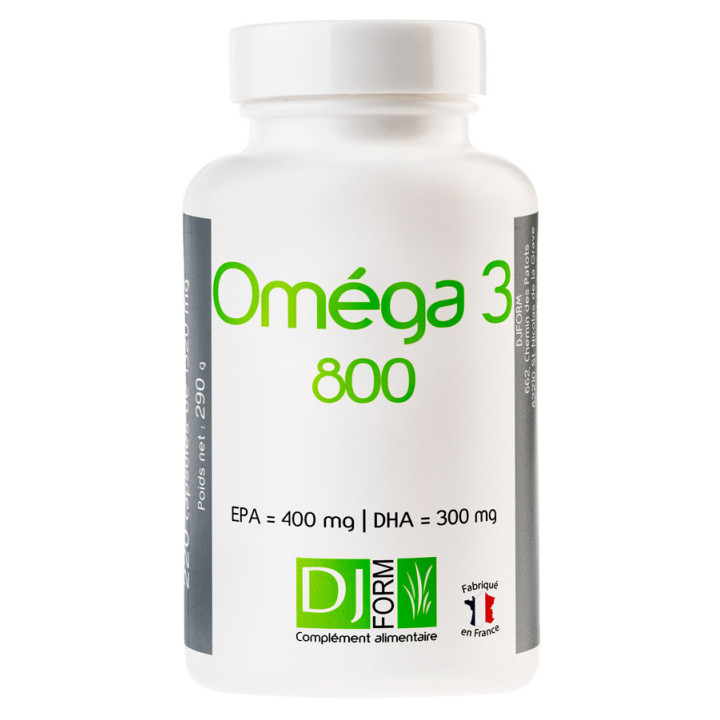
EXCEPTIONAL QUALITY RARE ON THE OMEGA 3 MARKET: A VERY HIGH CONCENTRATION OF EPA AND DHA .
Price:
€58.90
Tax included
Read the 65 reviews
Average rating:
9.9/10
Number of reviews: 65
Best before*: 09
* Minimum Durability Date = date until which the product retains all its organoleptic, physical or nutritional qualities. It is completely safe to consume a product beyond this date.
Buying this product you will collect €1.00 with our loyalty program.
Safety Guarantees
Shipping Policy
Return Policy
A wild fish oil naturally concentrated in essential omega 3.
Djform Omega 3 800 is a premium wild fish oil (sardines, anchovies, and herring) that naturally concentrates the essential fatty acids our bodies need: eicosapentaenoic acid (EPA) and docosahexaenoic acid (DHA). These are synthesized from alpha-linolenic acid (ALA), an omega-3 fatty acid obtained exclusively through our diet.
Omega-3 EPA and DHA promote the production of prostaglandins (hormones that mediate and regulate our body), which play an essential role in our body:
Omega-3 EPA : all our cells need it; it promotes cellular and cardiovascular protection, reduces the risk of degeneration and premature aging, allergies, and inflammation. It is essential during growth, but also during periods of stress and fatigue.
Omega-3 DHA : like EPA, it helps protect our cells against degeneration and premature aging. It plays a particularly important role in the brain and retina, contributing to their normal function.
Our daily diet is supposed to cover our needs for essential fatty acids. However, our consumption is mostly insufficient: in its last opinion in March 2010, the French Agency for Food Safety (Afssa, now ANSES) recommended a daily nutritional intake of at least 250 to 500 mg of EPA/DHA combined for children depending on their age and at least 250 mg of DHA and 250 mg of EPA for adults.
A population deficient in omega-3?
A report from ANSES in September 2015 highlighted a significant imbalance in our diet between the intake of poor quality saturated fatty acids consumed in excessive quantities, and polyunsaturated fatty acids (including the “good fatty acids”, omega 3 and 6 in particular), of which we are in principle deficient.
Regarding EPA and DHA intake, this report highlights that the proportion of people “at risk of deficiency [is] close to 90%”.*
Western populations are largely deficient in omega-3 for multiple reasons:
Foods that are supposed to contain omega-3, including meat, milk and eggs, no longer contain as much due to changes in the diet of farm animals: they are now mainly fed omega-6 (corn, soy, sunflower) and no longer have as much access to spring pasture or hay, which nevertheless enrich animal products with omega-3.
Our diets containing polyunsaturated fatty acids (including omega-3 and omega-6) are currently largely unbalanced. While our omega-6 intake is often excessive, our populations are largely deficient in omega-3. Yet, a proper ratio between these two fatty acids is essential: the more omega-6 we consume, the more omega-3 we should consume. The current average ratio is estimated to be between 15 and 30 omega-6 to 1 omega-3, whereas it should be a maximum of 5 omega-6 to 1 omega-3.
Our plates no longer contain as many foods rich in omega 3, such as oily fish (sardines, herring, mackerel in particular) or not frequently enough (2 to 3 times a week).
Vegetable oils alone cannot meet our omega-3 deficiencies: oils rich in omega-3 primarily contain ALA, which our bodies convert into EPA and DHA. However, our conversion rate of ALA to DHA is too low to meet our needs.
Omega-3s: For whom? For what purpose?
Omega-3 fatty acids are essential for the proper functioning of all cells in our body and our skin. They are known to lower cholesterol and reduce pain and inflammation.
Among them, EPA and DHA contribute particularly to the normal functioning of our heart, brain, and vision.*
For the cardiovascular system (heart, arteries, veins, capillaries, coronary arteries, etc.):
The EPA and DHA contribute:
to the maintenance of normal cardiac function;
to maintaining a normal concentration of triglycerides in the blood, an excess of which can contribute to the development of heart disease;
to a decrease in blood pressure in people with high blood pressure;
to a reduction in cardiovascular morbidity and mortality in people with pre-existing cardiovascular conditions.
For the brain and nervous system balance:
DHA, the main lipid in the tissues that make up our brain, contributes to:
to normal brain function (from 250 mg/day of DHA); it thus provides major support to the brain functions of children, adolescents and students as well as seniors;
to the normal development of the brain of the fetus and the breastfed child. The French Agency for Food, Environmental and Occupational Health & Safety (ANSES) reminds us that omega-3 fatty acids are essential for women of childbearing age, pregnant women, breastfeeding women, and children.
Furthermore, EPA and DHA “play a role in brain function in adults and during aging and suggest a positive effect on maintaining mental health (depression, dementia including Alzheimer’s disease)”*.
For the immune system:
A growing body of research within the global scientific community supports a link between omega-3 fatty acids and immune system support. They appear to boost our defenses against infections (viral and bacterial) and help reduce inflammation.
For the eyes and vision:
Our populations are subjected to a new type of oxidative stress, due to the daily use of screens that emit blue light, particularly among children, adolescents, and young adults, and sometimes even very young children. Supporting our eye health has become essential to avoid the risk of developing vision problems and degeneration at increasingly younger ages.
DHA contributes to:
to maintain normal vision in children and adults;
to the normal development of the eyes of the fetus and breastfed child and to the vision of infants under 12 months.
Furthermore, EPA and DHA “are involved in the prevention of age-related macular degeneration”* because their deficiency can increase the risk of this degeneration.
How to choose between Omega 3 DHA and Omega 3 800 (EPA and DHA)?
Omega-3 DHA stands out for its direct impact on brain function. To fully benefit from it, it's necessary to choose a product rich in DHA and low in EPA, like our Omega-3 DHA, ideal for targeted support. Omega-3 DHA is recommended for retinal health (particularly in the prevention of age-related macular degeneration, AMD) and for maintaining cognitive function (memory, concentration). It is an ideal choice for seniors, teenagers, and pregnant women.
Our Omega 3 800, meanwhile, ensures an optimal balance between EPA and DHA. EPA is renowned for its powerful anti-inflammatory effects, its beneficial effects on the skin, and its cardiovascular benefits, while DHA supports brain and retinal health. We recommend it for those seeking a balanced and complete omega-3 intake.
Djform Quality:
Because omega-3s are highly sensitive to oxidation, extraction processes are crucial to ensure an oil of impeccable quality.
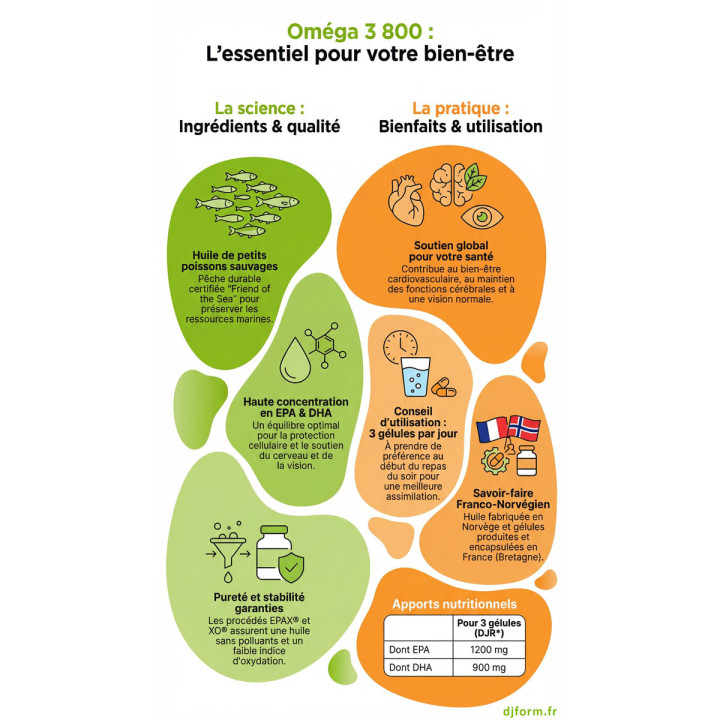
The Epax® process is implemented in Ålesund, Norway, where the oil is produced. The fish arrive directly in Norway, where the oil is extracted at low temperatures and purified to guarantee its quality. The Epax® process ensures concentrated marine omega-3 products made with high-quality ingredients, committed to sustainability, traceability, safety, and purity. It represents the pinnacle of quality in omega-3 products today.
The XO® process is implemented in France during the encapsulation of omega-3 oil. This process now guarantees purity criteria superior to the GOED (Global Consortium of Omega-3 Producers) standards and superior to European regulatory standards:
oils of great purity, very concentrated in omega 3 EPA and DHA (and very low in saturated fatty acids, the "bad" fats).
oils in the form of triglycerides, “polyunsaturated” fatty acids (the “good” fats) essential to our health.
oils free from harmful pollutants and heavy metals.
Non-oxidized oils guaranteed by the TotOx index. The lower this index, the better it is.
Oils made from wild fish rigorously selected for their richness in omega-3: the fish caught are almost 90% small fish from the cold waters of Peru (anchovies), which contain fewer pollutants due to their small size and reproduce very quickly, allowing for rapid population renewal. The ocean off the coast of Peru and Chile is a cold sea, contrary to what one might think, because of the Ring of Fire in the Peru-Chile Trench, which brings up icy, nutrient-rich water from the depths.
Protecting marine resources: Epax® oils are Friend of the Sea certified. This label guarantees environmentally and socially responsible fishing: sustainable and well-managed fishing areas, ecological methods, standards for worker health and safety, testing of catch samples for traceability, etc.
The capsules are encapsulated in Pleuven, Brittany, France. The softgels are also made in France , in Brittany.
Why don't we use vegetable capsules for our Djform products?
The “vegetarian capsule” is vegetarian in name only! Behind a marketing facade, the vegetable capsule actually contains chemical residues. To always offer you the highest quality products possible, DJFORM has made the difficult but conscious choice to continue using fish gelatin capsules, even if it means losing the organic label on some of its products.
To learn more - Nutritional deficiencies: our essential nutrient needs
For our bodies to function properly, they need a sufficient supply of nutrients. Ideally, the essential nutrients for our health (vitamins, antioxidants, amino acids, trace elements, minerals, fatty acids, etc.) should be obtained through a balanced and varied diet. But is this always possible?
In recent decades, our societies have adopted new production methods (use of pesticides, harvesting fruit before it is ripe, selection of more resistant and productive fruit and vegetable varieties that are deficient in essential nutrients, etc.) and different lifestyles and consumption patterns (the widespread availability of ultra-processed and oxidizing industrial foods on supermarket shelves). As a result, the quantity and quality of these essential nutrients have significantly decreased in our current diet, as has their diversity.
Today, achieving a balanced diet to avoid deficiencies and insufficiencies in micronutrients essential to our health has become difficult.
Each individual has their own unique way of assimilating nutrients, and their needs for essential nutrients can vary greatly, particularly due to:
of his lifestyle and energy expenditure: sedentary, high-level athletes, arduous work, overwork, lack of time, lack of sleep and recovery, eating on the go, etc.
of his addictions: regular or excessive consumption of sugars, tobacco, alcohol.
of one's psychological state: stress or chronic fatigue increases our needs;
of his age;
of his diet: extreme diets (veganism, raw foodism ... and often vegetarianism) deplete our intake; possible eating disorders.
To address the increasingly widespread deficiencies in essential nutrients, supplementation remains today an effective emergency response and a transition towards a more diverse, more balanced, more natural and better quality nutritional diet.
Contains no allergens or GMOs (in accordance with Directive 2003/89/EC).
Quality and Manufacturing Guarantee:
This food supplement has been manufactured in accordance with GMP standards by an approved laboratory. GMP stands for Good Manufacturing Practices in force throughout the European pharmaceutical industry. This food supplement is guaranteed non-irradiated, as are each of its ingredients.
Directions for use:
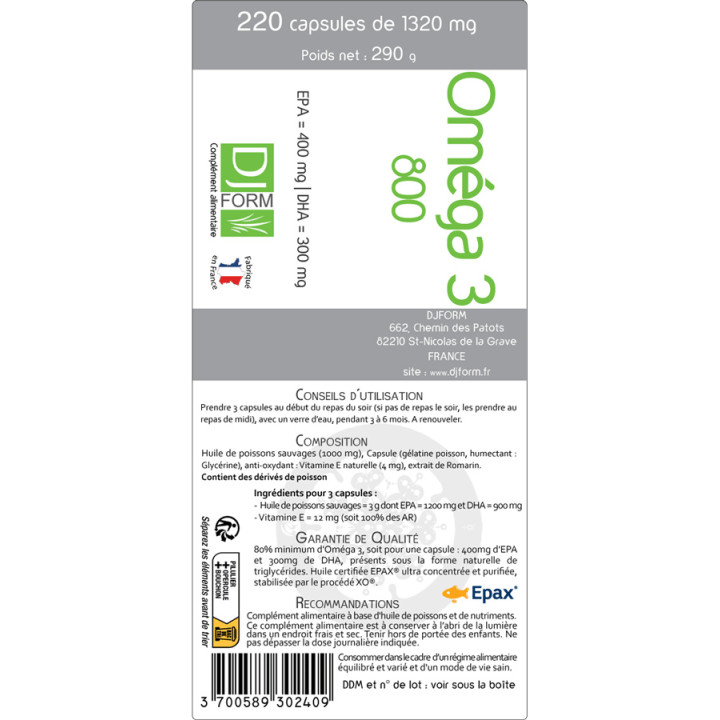
Oméga 3 800 Djform is recommended throughout the year or as a 3 to 6-month course of treatment minimum. Take 3 capsules of Oméga 3 at the beginning of the evening meal (as omega 3 are better assimilated in the evening).
Precautions for use:
Do not exceed the recommended daily dose.
Warnings:
Does not replace a varied and balanced diet and a healthy lifestyle. If you are undergoing medical treatment, please consult your doctor. Keep out of reach of children.
Keep out of reach of children.
Storage instructions:
Store in a cool, dry place away from light. Ideally, store in the refrigerator. When ordering multiple boxes, we recommend storing them in the refrigerator to ensure optimal preservation over time.
EPAX® and XO® Quality:
EPAX®: One of the strictest specifications to obtain an oil of very high purity, stability, and quality.
XO®: A cutting-edge, high-tech manufacturing process to guarantee an oil whose purity standards are well above current regulations.
Say no to pollutants: unique and exclusive oil purification processes to obtain a product free of pollutants, heavy metals, pesticides, PCBs, and other harmful chemical substances.
Friend of the Sea certification.
Oil in Triglyceride form, the "good fats".
100% fish gelatin capsule manufactured in France (in Brittany).
Oil manufactured in Norway and encapsulated in Brittany.
Q&A:
I find the capsules a bit large. Is it possible to cut them in half?
It is not possible to cut them in half because they contain oil. However, you can chew them. From experience, the oblong shape of the capsules makes them easy to swallow with a little water; it is more of a psychological barrier that makes us think it would be complicated to swallow them.
I read that taking 1000 mg of omega-3 could help, but the dosage for your omega 3 800 recommends taking 3 capsules of 1000 mg: is this a bit too much, or are the standards I read about too low?
You need to make the distinction between 1000 mg of omega-3 and 1000 mg of omega-3-rich oil, because an oil never contains 100% omega-3. Ours is standardized to over 80% omega-3. Our dosage is based on experience: too little omega-3 and there is little to no effect. Today, we are more concerned with an omega-3 deficiency than with excess. Furthermore, an overdose of omega-3 with 3 capsules (or even 6 capsules) is impossible. That is why we recommend an average of 3 capsules per day.
Could you tell me if your omega 3 800 capsules are suitable for young children? If so, what is the dosage?
There are no omega-3s for children and others for adults. The only difference is the dosage. Up to 3 years old: 1 capsule per day. For infants, you will need to pierce the capsule and mix the contents into their food.
You recommend taking 3 capsules per day, which corresponds to a dose of 1200 mg of EPA and 900 mg of DHA. This is much higher than the recommendations made by other brands. Should this recommendation be adapted depending on a person's build? I am a petite woman (1.57 m and 49 kg), and I already make an effort to consume omega-3s (hemp oil that I pour over my dishes before eating them). Should I take 3 capsules, or could 2 be enough?
The dosage we recommend is the one that allows you to get all the benefits of the dietary supplement. I would like to remind you that today, no one is able to say what our exact needs are, and furthermore, recommendations vary over time and by country. Some competitors have a purely commercial dosage. They offer small packaging sizes that appear inexpensive (if you don't look at the price per capsule). Their dosage is therefore adapted to these small boxes (60 capsules) so that the box lasts 1 to 2 months. Our policy is different: to offer the best quality at a price that allows you to consume our products daily over the long term. By reducing the dosage (which is a guideline, as some people take more and others less than we advise), you risk not getting all the benefits of omega-3s (especially those for the skin). Remember that the more stressed you are, the drier your skin is (heels, knees, and elbows), and the older you get, the more omega-3s you need. Finally, oils rich in ALA (plant-based omega-3) are of little interest because our ability to convert this omega-3 into EPA and DHA is unpredictable and, in any case, very low. And the big problem with these omega-3-rich plant oils is that they also contain far too much omega-6. For example, hemp oil contains 24% omega-3, but most importantly 60% omega-6. However, there is competition between the two, and omega-6 always wins.
The Totox value on the certificate of analysis shows 10 and not 5.9. Is this an error on your part?
It is not always easy to read a certificate of analysis. There are several columns: Min. value = minimum values to comply, Max. value = maximum values to comply, and Result = Measurements taken on the current batch. It is this last value that corresponds to the measurement you need to take into account.
Excellent produit
09/20/2026
Jean
Je recommande
*****
06/21/2026
Pascale
Very satisfied
Automatically translated from French
Oméga 3 800
04/26/2026
Marie
Very good product!Top quality!
Automatically translated from French
The only omega 3 that work
10/05/2025
Katelllh
We use them 6 months out of 12, the kids, my husband and myself. Exceptional quality like all DJFORM supplements
Automatically translated from French
Omega 3 800
09/22/2025
Cécé
Very good quality I recommend
Automatically translated from French
Perfect
09/15/2025
Valerie
Very good product, very good EPA and DHA concentration.I regularly renew my order.Complete confidence
Automatically translated from French
Very good product
09/15/2025
Valerie
Capsules might seem big but swallow very well.Very happy, very good EPA and DHA concentration.Complete confidence in the brand
Automatically translated from French
Very good
09/02/2025
Pascale
Very satisfied
Automatically translated from French
Satisfaction
03/15/2025
Xian
Total satisfaction for a long time.
Automatically translated from French
Excellent
01/15/2025
Didier P.
Very good natural co Enzyme Q10 essential to protect mitochondria from 50 years onwards
Automatically translated from French
Good
12/18/2024
Sam
I just tested it but too early to get an idea.But what is important to me is the natural side.
Automatically translated from French
more than satisfied
11/27/2024
SOFIANIED
very happy with the product, top quality, one of the best on the market.
Automatically translated from French
OMEGA 3
10/03/2024
Marie C.
Supplement taken throughout the year due to difficulties in getting a sufficient and quality intake from food.
Automatically translated from French
essential
09/02/2024
sergio
i've been using DJform dietary supplements for several years and I am very happy with them.the prices are attractive, the products too, the service is great and payment facilities are available. so everything is fine...
Automatically translated from French
Skin and eyes well hydrated
08/06/2024
Irène
My skin and dry eyes are well repaired, thank you very much, omega 3 800 DJFORM.
Automatically translated from French
Oméga 3
07/30/2024
Romain
Quality product
Automatically translated from French
Very good product
07/21/2024
Bebert
Product that seemed expensive to me, but upon receipt, I realized it was a big box, so not disappointed at all. Very effective. Since I've been taking it, I feel better, no more deficiency like before.
Automatically translated from French
It works, I feel the positive effects
07/09/2024
Nature
I have dry eye syndrome, and with Omega 3 800 everything is back to normal.
Automatically translated from French
good product
06/21/2024
sergio
happy with this product which I buy for my neurons, and which I have been using for quite some time along with many other products from DJform
Automatically translated from French
Régine
04/27/2024
Régine
Very good supplement that I take every day
Automatically translated from French
Omega 3800 in capsules
03/27/2024
Martine
Not enough hindsight to evaluate the benefits
Automatically translated from French
Omega 3
02/18/2024
Mof
Very good productNew packaging pleasant
Automatically translated from French
The best
02/17/2024
Sophie
The best Omega 3 I have tested, it has become a must-have for me
Automatically translated from French
OMEGA 3 800
01/23/2024
CrocBlanc
Very good quality. Effective on concentration and general condition. To be taken long term or replaced by small fatty fish several times a week
Automatically translated from French
Very good
12/24/2023
Bouedo
You have to roll the a bit large capsule around in your mouth before swallowing it, it's a bit scary.
Automatically translated from French
Perfect
12/22/2023
Yann
Very good quality
Automatically translated from French
Omega 3
12/18/2023
Sylvie
Very happy with the product
Automatically translated from French
Effective from all points of view
12/15/2023
Pascale
My hair is much nicer, my health is going pretty well. I recommend to all my family and others.
Automatically translated from French
Excellent
12/03/2023
GIBI
Good product, triglyceride reduction of 30%
Automatically translated from French
among the top 3
12/03/2023
Michel L.
excellent Epax certified product. Too bad the old large packaging no longer exists!
Automatically translated from French
Excellent Oil
11/24/2023
Nature
It brings me a lot of benefits for my high blood pressure, my dry eyes, my osteoarthritis and my osteoporosis. I can't do without it, given that I eat very little fish. So I take 3 a day in the evening and I also give them to my two boys aged 19 and 21 who don't really like seafood either. So 3 gélules a day is easy, but we still try to eat sardines once a week. With omega 3 800, chronic stress reduced by 90%, well-hydrated eyes, and my son who has A.D.H.D. really needs it. This oil is paying off. When I follow the treatment regularly, I only put one drop of eye drops for the day, but if I don't take capsules for 3 days, I spend the day putting drops in 5 or 6 times a day. It's awful, eyes on fire!
Automatically translated from French
Good product
11/24/2023
Lydia
Meets my expectations.
Automatically translated from French
Moisturizing oil for my eyes
11/24/2023
Nature
I eat very little fish so I take Omega 3 quite regularly. Since I have dry eyes I feel the beneficial effects of the oil. Thus, my vision is improving well since I am astigmatic, presbyopic, severe high blood pressure, so really only good things, I notice a clear difference.
Automatically translated from French
Dry eyes well hydrated
11/18/2023
Nature
My 19-year-old son and I both have dry eyes and Omega 3800 saves us from eye drops. DJFORM products work 100%, they are outstanding products.
Automatically translated from French
it deserves five stars
11/06/2023
regine
very good supplement. I take three every day, in the evening, and have been doing so for years. I notice the effects on my skin, my hair, my mental state and my general well-being.
Automatically translated from French
Omegas
11/06/2023
Vincenza
10
Automatically translated from French
Omega 3
10/29/2023
Cat
Top quality for all the products on this site and I recommend the Omega 3 which I take as a cure. Very effective in reducing my hair loss and my skin is much nicer
Automatically translated from French
Omega 3
10/22/2023
Lucrèce
You get a 3-month supply and you can be sure the product is of high quality
Automatically translated from French
Well assimilated
09/12/2023
Laetitia
Currently taking them, but I can assure you that they are very well digested unlike other brands
Automatically translated from French
Omega 3
07/20/2023
Odile
Very good product. Suitable packaging.
Automatically translated from French
Great
06/13/2023
Céline
Very happy with this very good quality product. I give it to my children every day. They have no difficulty swallowing it.
Automatically translated from French
Omega 3 800
05/30/2023
Syl34
Excellent product
Automatically translated from French
Good quality
05/13/2023
Lille
Very
Automatically translated from French
Omega 3
05/06/2023
Koko7660
3 gélules is it enough?
Automatically translated from French
Answer:
Yes that is what is recommended.
Oméga 3 800 - Djform
04/24/2023
Alain C.
Complicated to know exactly the impact of these Omega 3 on health since you don't feel anything in particular. I haven't really seen big differences in my fitness level between before, during and after the cure
Automatically translated from French
Time will tell
04/20/2023
Evelyne
My husband and I have been taking your food supplement for only 3 weeks. I think it is much too early to have a feeling about it.
Automatically translated from French
Very good product
04/12/2023
Pasquet D.
Omega 3 are essential to control inflammation provided they are of quality and a very low totox which is the case here it is perfect I recommend this product.
Automatically translated from French
great product
04/08/2023
sergio
very good product and reliability from DJform
Automatically translated from French
Very good value for money
03/17/2023
Dom
Excellent product that I use regularly and for almost two years. Given its high omega 3 content and the checks carried out, the value for money is excellent.
Automatically translated from French
Omega 3
03/07/2023
CHARLES D.
Completely satisfied
Automatically translated from French
Omega 3800
03/02/2023
Anne2604
Excellent results
Automatically translated from French
Excellent
03/02/2023
Vivi
Helps me among other things to have beautiful skin and a balanced hormonal system.
Automatically translated from French
These Omega 3 DJForm are very good
03/02/2023
Pieril
These capsules are very good, bigger than the market average, so I think one per day is largely enough.Long-term global rebalancing effects advised by many naturopaths on health, actually it works well.
Automatically translated from French
Very good product
02/27/2023
Martine
Very good product, effective! It remains a bit expensive
Automatically translated from French
Boosts immunity and concentration
02/26/2023
CrocBlanc
For over 2 years, the whole family (2 adults, 2 teenagers and a child) has been taking the indicated dosage: we breeze through bouts of tonsillitis, nasopharyngitis, colds or mild flus without even seeing them at our house. Finally, it seems to me that omega 3 boosts my capacity for concentration.
Automatically translated from French
maximum rating
02/26/2023
Ah b.
At a rate of four gélules/day, because I am an old vegetarian, for nearly four months, I imagine making up for any deficiencies. Hard to notice an improvement, as it is essentially mental.
Automatically translated from French
Good supplement
02/25/2023
Marie
A subscriber to David's videos, I order on your site to supplement myself
Automatically translated from French
Oméga 3800
02/25/2023
Cendrine
My husband and I have been taking them for several months and frankly our bodies thank us. More vitality, magnificent skin and complexion, less shortness of breath during exertion and many other benefits. I think we will take them long term.
Automatically translated from French
Omega3
02/25/2023
Danielle
Since I don't really like small fish containing Omega3, I do a cure from time to time, and always those from this shop
Automatically translated from French
Omega
02/24/2023
Isabelle
Entirely satisfied
Automatically translated from French
Delivery
02/24/2023
Zuzana
Very satisfied with the speed of delivery because I am in Tahiti and I got my products in barely two weeks I will order my Omega 3 from you again and if I need anything else I will go through youThank you
Automatically translated from French
Very very Effective OMEGA 3 800
02/24/2023
Irène
For my son who has ADHD, very chronic stress, and dry eyes, it works very well. I also have dry eyes and the result is there. Plus the cod liver oil, it's great, it repairs well. I am very satisfied with DJFORM products.
Automatically translated from French
Personal
02/24/2023
Maryse
Satisfied
Automatically translated from French
I can't do without it anymore
02/24/2023
Patience
Great product, which I rank as number 1 compared to the supplements I have already tested, even though it turns out to be difficult to rank them since they are so exceptional (the ones I bought). I have enough hindsight to state this having used a good number of supplements for a few decades.

 Read the 65 reviews